Meet the author:
Jill Olkoski
Jill has a MA in Clinical Psychology, a BS in Computer Science, and a BS in Mechanical Engineering.
She currently owns Aldebaran Web Design in Edmonds (near Seattle WA) and enjoys educating her clients on topics related to small business website design.
In Jill's previous life, she spent 17 years in the engineering and quality organizations of a Fortune 100 tech company.

|
May 5th, 2016
Here’s a great tip for viewing what’s in Google’s index:
site:yourwebsite.com
Here are some varations:
site:yourwebsite.com word
This returns all pages that have “word” on them.
Example: “site:aldebaranwebdesign.com jill” will show all the pages on my site that are in Google’s index that contain the word “jill”.
site:yourwebsite.com inurl:word
This returns all pages that have “word” in the URL of the page.
site:yourwebsite.com -inurl:word
This returns all indexed pages except where “word” is part of the page’s URL.
Example: “site:aldebaranwebdesign.com -inurl:blog” will show all the pages on my site that don’t contain the word “blog” in the path.
If you found this article helpful, please take a moment to share it with your friends, it will be much appreciated. Thanks! Jill
Posted in SEO and PPC, Tidbits | Comments Off on Show What’s in Google’s Index with Exclusions
April 23rd, 2016
I had two clients alert me that contact forms on their BlueHost hosted websites were generating errors. One was using WordPress and Contact Form 7. The other was using a regular mail form script using the PHP Mail function, using secure auth, with PEAR and AUTH enabled. The contact forms used to function, so I checked the version of PHP. Both broken contact forms were running PHP 5.6 - yet other clients who were running 5.4 were having no issues.
I contacted BlueHost tech support and reported this, and they said it was my script. I told them no, it wasn’t, it used to work and now it’s broken, and 5.4 works and 5.6 doesn’t. They said I could revert back to 5.4, and I said why don’t they fix what’s wrong with 5.6. They told me to submit a ticket, that was a week ago no reply.
Today I logged in and to my surprise, this is what I saw:
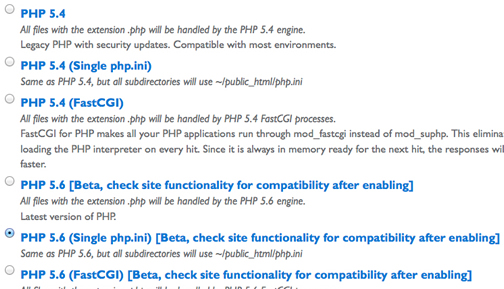
So BlueHost is moving folks to 5.6, which is in BETA, breaking scripts, and when you call in for help, they tell you it’s the script, not the version of PHP.
Maybe if more folks complain, they’ll actually fix 5.6 and not migrate anyone without telling them.
If you found this article helpful, please take a moment to share it with your friends, it will be much appreciated. Thanks! Jill
Posted in Tidbits | Comments Off on BlueHost PHP 5.6 Breaking WordPress Contact Forms and Other Mail Scripts
February 21st, 2016
I was working on my new website: SoloDogs.net, and needed to have a series of three images. I wanted the desktop version to be centered on the page. I wanted the mobile version to have each image also centered, but stacked one on top of another. I also wanted the text below the images to be beneath the last image, no matter what. Here’s the solution:
<div style=”text-align:center;”> // Outer Container
<div style=”display:inline-block;”>image 1</div>
<div style=”display:inline-block;”>image 2</div>
<div style=”display:inline-block;”>image 3</div>
</div>
<div style=”clear: both;”>Text you want below the images</div>
If you found this article helpful, please take a moment to share it with your friends, it will be much appreciated. Thanks! Jill
Posted in Tidbits | Comments Off on Multiple Images Centered on Page: Mobile Friendly
January 30th, 2016
Here’s a great tip on how to password protect a zip file on a mac so that you can email it to someone safely.
1. Open a Terminal Window (Applications -> Utility -> Terminal)
2. Type zip -er FileNameYouWantOfZippedFolder.zip
3. Put a space after the .zip above
4. Drag and drop the folder you want to zip into the Terminal window
5. Hit return
6. Enter password
7. Verify password
8. The file will be created in a default location, under your user account.
Alternatively, you can cd to whereever the file is in the Terminal window, then zip the file, and it will put it where you cd’d to.
The entire syntax:
zip -er MyNewZipFile.zip SuperSecretFolder
If you found this article helpful, please take a moment to share it with your friends, it will be much appreciated. Thanks! Jill
Posted in Tidbits | Comments Off on Mac Tip: How To Password Protect A Zip Folder So You Can Email It Safely
November 24th, 2015
If you found this article helpful, please take a moment to share it with your friends, it will be much appreciated. Thanks! Jill
Posted in Uncategorized | Comments Off on Space Travel: Blue Origin’s Rocket Landing
November 23rd, 2015
Here’s a great tip that worked for me to help speed up how quickly Dreamweaver CS6 opens files for the first time:
https://helpx.adobe.com/dreamweaver/kb/hang-opening-document-dreamweaver-cs5.html
“When you try to open a document in Dreamweaver CS6, it takes anywhere from 30 seconds to several minutes for Dreamweaver to open it. Dreamweaver stops responding until the document opens.
Solution:
Disable Dreamweaver’s Resolve To IP Address feature using the instructions for your operating system.
- Quit Dreamweaver.
- In the Finder, navigate to the following location: /Users/Your User Name/Library/Preferences
- Open the Adobe Dreamweaver Prefs file in TextEdit.
- Locate the [REMOTE DOWNLOAD] section in the file.
- At the bottom of this section, add a line that says: resolveremoteurltoipaddress=FALSE
- Save file.
If you found this article helpful, please take a moment to share it with your friends, it will be much appreciated. Thanks! Jill
Posted in Uncategorized | Comments Off on Dreamweaver CS6 Running Slow When Opening Files
August 23rd, 2015
Sometimes you install WordPress in subdirectory, as in when you are converting a person with a pre-existing website to a WordPress website. Generally to keep things clean, you install WordPress in a subdirectory, and then move the content into WordPress. When you’re finished, you now need to “launch” the new website, but have it appear that WordPress was installed into the root directory.
Read the rest of this entry »
If you found this article helpful, please take a moment to share it with your friends, it will be much appreciated. Thanks! Jill
Posted in Tidbits, Tutorials | Comments Off on WordPress Installed in SubDirectory
July 21st, 2015
If your website is hosted by BlueHost, this post may help you avoid a problem I had with a client’s website when we attempted to download a backup of the website and expand it.
Read the rest of this entry »
If you found this article helpful, please take a moment to share it with your friends, it will be much appreciated. Thanks! Jill
Posted in Tidbits | Comments Off on Backing Up Your Website on BlueHost using “Full Backup”
July 13th, 2015
Here’s a nice fav icon generator and how to force all browsers to use a new one if you’ve just changed it.
Fav Icon Generator:
http://www.favicon-generator.org/
How to force a browser to use new Fav Icon:
http://stackoverflow.com/questions/2208933/how-do-i-force-a-favicon-refresh
<link rel=”shortcut icon” href=”http://www.yoursite.com/favicon.ico?v=2″ />
If you found this article helpful, please take a moment to share it with your friends, it will be much appreciated. Thanks! Jill
Posted in Tidbits | Comments Off on Fav Icon
April 28th, 2015
I have received no less than four text messages, all sent from a different phone number, with a similar message. An alleged “hearing impaired person” wants to know if I can “handle website design for a new company” and wants to know if I “accept credit cards as form of payment”. After the first two texts, I replied no, and please stop texting me. Now I’ve received an email with the subject “Web Design Is Needed” and the message is:
Hello I am Micheal Jay and i am hearing impaired i need know if you can handle website design for a new company and i also need to know if you accept credit cards as form of payment ?
The email I received today was from
[email protected] and sent from a hotmail account, IP
65.55.90.71
This has all the markers of some kind of scam targeting web designers.
Here are links to similar reports:
http://wolfcreektechnology.com/post/Scam-Targets-Web-Designers
http://blog.ihenix.com/nearly-got-scammed/
If you found this article helpful, please take a moment to share it with your friends, it will be much appreciated. Thanks! Jill
Posted in Spam Watch | Comments Off on Hearing Impaired Website Design for New Company and Wants to Pay With Credit Card
|
| ©2006 - ©
Aldebaran Web Design Seattle, A DBA of Aldebaran Services LLC |
|
|
|